
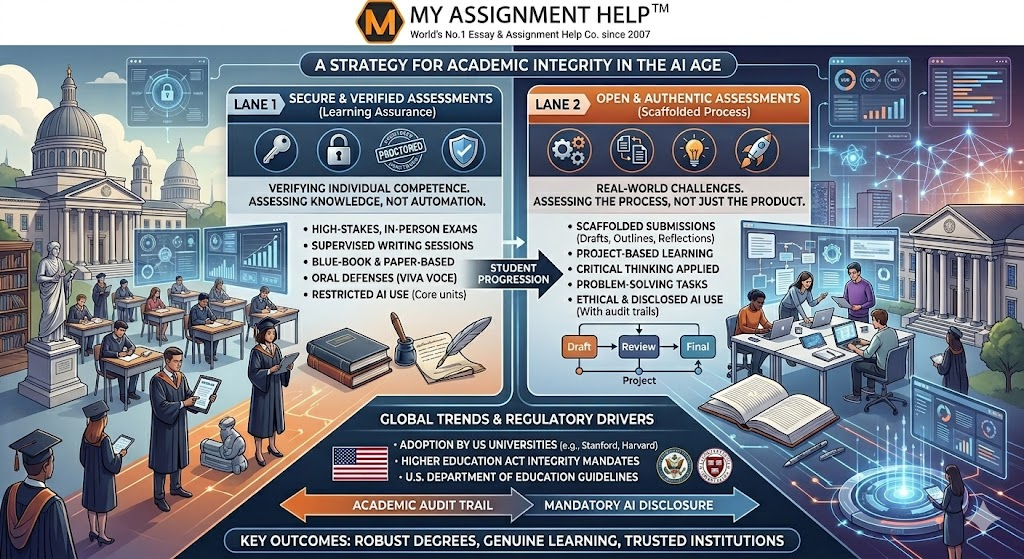
The landscape of American higher education is currently navigating its most volatile era since the shift to remote learning. As we move through 2026, the initial “wait and see” approach to generative AI has officially ended, replaced by a “regulatory-led” framework. For students at institutions from the Ivy League to state colleges, understanding these shifts is no longer optional—it is a baseline requirement for academic survival in an era where AI-generated content is under federal and institutional scrutiny.
The 2026 Pivot: From Detection to Learning Assurance
For years, academic integrity in the US was managed through a “detection-first” lens, relying on Turnitin or GPT-zero to catch plagiarism after the fact. However, the 2026 updates from the U.S. Department of Education and recent amendments to the Higher Education Act acknowledge a new reality: in an age of seamless automation, the traditional “police and punish” model is broken.
Instead, the new standards focus on Learning Assurance. This means universities like Stanford and Harvard, which recently updated their 2026 AI Frameworks, now require students to prove they have genuinely mastered learning outcomes through “secure” and “authentic” assessments. Whether you are navigating these new hurdles at a domestic or international level, staying compliant requires a proactive strategy. If you find the new assessment rubrics overwhelming, seeking professional assignment writing help can provide the clarity needed to align your work with these updated institutional expectations.
The “Two-Lane” Model: A Global Trend Hits the US
A major conceptual shift gaining traction across US campuses is the implementation of a dual-lane assessment framework. Originally popularized in the Australian (TEQSA) and UK markets, this model is now a global gold standard that US universities are rapidly adopting to verify student competence:
- Lane 1: Secure Assessments
These are high-stakes, in-person, and supervised tasks. Institutions are shifting core midterms and finals back to blue-books and proctored environments to ensure that the individual student—not an algorithm—is the author of the knowledge. - Lane 2: Open & Authentic Assessments
These tasks reflect real-world challenges. While they may allow the ethical use of AI tools, they require “scaffolded” submissions. This means students must submit a trail of drafts, outlines, and reflections to show the process of their work, not just the final product.
The Legalization of Academic Integrity
Perhaps the most jarring change in 2026 is the movement toward stricter legal definitions of “contract cheating” and “AI fraud” under US consumer protection laws. With the Higher Education Act seeing new emphasis on “programmatic integrity,” universities are under federal pressure to report significant integrity breaches that could impact federal funding.
For students, this means that “unintentional AI plagiarism” is increasingly difficult to use as a defense. The burden of proof has shifted; you are now expected to maintain an “audit trail” of your research. Because the stakes have never been higher for your GPA and future career, many students choose to buy assignment online from reputable sources to use as high-quality study guides, ensuring they understand the complex referencing and structural requirements demanded by these 2026 frameworks.
Data Insights: The AI Impact on Integrity
Recent 2026 data from the National Center for Education Statistics suggests that while 82% of US faculty now integrate AI into their curriculum, the risk of “source fabrication” remains the primary concern for 61% of academic boards. The 2026 AI Governance Guidelines now explicitly state that failing to “label and log” AI usage is officially classified as academic dishonesty, regardless of the quality of the output.
| Category | Pre-2026 Standards | 2026 US Higher-Ed Shift |
| Primary Goal | Plagiarism Detection | Learning & Process Assurance |
| AI Policy | Vague/Professor-led | Institutional AI Frameworks (e.g., Stanford Model) |
| Assessment Type | Mostly Digital/Take-home | Hybrid: Lane 1 (Proctored) & Lane 2 (Scaffolded) |
| Federal Oversight | Institutional Autonomy | Higher Education Act Integrity Mandates |
Key Takeaways for 2026
- Process over Product: Your final essay matters less than the evidence of how you wrote it. Always save your version history and research notes.
- The “Secure” Requirement: Expect more “viva voce” (oral exams) and supervised writing sessions, especially in STEM and Law.
- Disclosure is Mandatory: If you use AI for brainstorming or structural help, it must be cited. Hidden AI usage is now a fast-track to academic probation.
- Institutional Accountability: US universities are now audited on their “Assessment Plans,” making them more vigilant and less likely to overlook minor infractions.
FAQ: Navigating the 2026 AI Crisis
Q: Can I still use AI tools for my assignments in 2026?
A: Yes, but only within the “Lane 2” authentic assessment guidelines. Most US colleges now require a “Statement of AI Usage” to be submitted alongside every major project.
Q: What happens if my work is flagged by an AI detector?
A: Under 2026 policies, a flag is usually the start of an “Assurance Review.” You will likely be asked to explain your “audit trail” or defend your thesis in a short interview with your department head.
See also: Crypto Ecosystem Expansion Strategies
Q: Do these rules apply to online and hybrid degrees?
A: Absolutely. Many online programs have integrated third-party proctoring and biometric verification to satisfy the Lane 1 “secure” requirement.
Author Bio
Lachlan Miller is an Academic Strategist and Senior Content Lead at MyAssignmentHelp. With over a decade of experience in global higher education policy, Lachlan specializes in helping students navigate the complexities of US university frameworks and AI compliance. He currently leads a task force dedicated to the “2026 Learning Assurance Model,” ensuring students meet the highest standards of academic integrity.

