

I’m not here to talk you out of anything. If Peptide Sciences was your source and it’s gone, you’re probably already looking at what’s next, and you’re going to make a choice regardless of what I say. So let’s skip the lecture and get to the part that actually protects you.
Here’s the thing nobody selling you a “top 10 replacements” list wants to admit: the list is useless the moment the names change again, and in this market they always change. What doesn’t go stale is a way of thinking through it yourself. So instead of a ranking, I’m giving you five checkpoints. Think of it like a harm-reduction ladder: each one removes a specific, real risk. Skip a rung and that risk just sits there waiting for you.
The risk that matters most: what are you actually holding in your hand?
Before you ask which vendor, ask yourself a blunter question. Is the thing you’re about to inject a medicine, meaning a compound a licensed clinician has looked at and a licensed pharmacy has prepared, or is it a chemical, meaning a vial some retailer mailed you with a “research use only” sticker slapped on it and nobody checking on you at all?
For most of 2024 and 2025, that line was blurry on purpose. Sites sold the vial, printed the disclaimer, and let you connect the dots yourself. The disclaimer was doing all the work. As long as it stood, the chemical could pass itself off as something safer than it was.
That wall came down. On March 31, 2026, the FDA sent warning letters to seven online peptide sellers in a single day, including Gram Peptides and Prime Sciences, and rejected the “research use only” framing outright. Their words, straight from the Gram Peptides letter: “evidence obtained from your website establishes that your products are intended to be drugs for human use” [C2]. Translation: the regulator looked at sites talking up weight loss while selling bacteriostatic water and needles, and called the disclaimer what it had become. Wallpaper.
So here’s the honest floor, the first thing I’ll tell anyone: a mailed vial under a research disclaimer isn’t a cheaper version of the medicine. After 2026 it’s a different, riskier thing, sold by companies the FDA has already shown it’s willing to move against [C2]. If you’re going to do this at all, do it through a route with a clinician and a pharmacy in the loop. Everything below assumes you’ve made that call.
Know which bucket your goal actually sits in
This is where I want you to be honest with yourself, because the risk profile changes a lot depending on what you’re chasing.
If you’re going after weight loss, you’re in the well-studied bucket. Semaglutide, tirzepatide, and retatrutide (the last one still earlier in its research pipeline) all have real large-trial human data behind them. Here’s what that data actually looks like:
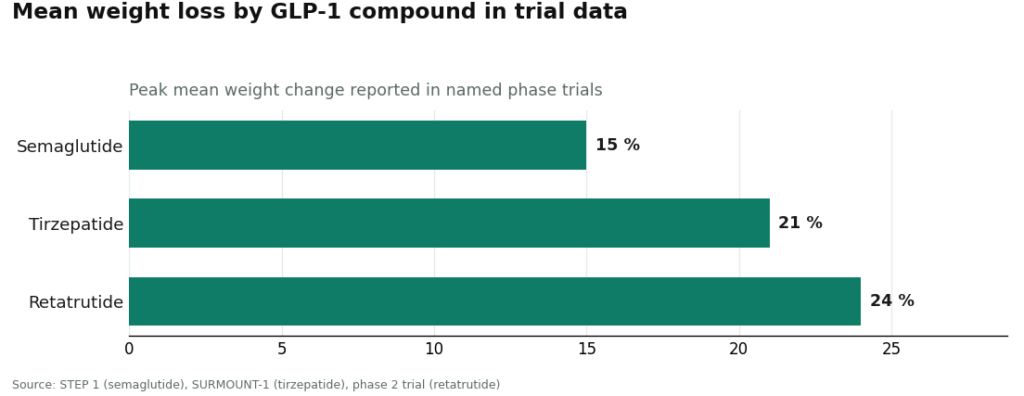
For this goal, the molecule itself isn’t the gamble. Your job is just making sure the dosing is controlled and titrated by someone who knows what they’re doing.
If you’re chasing recovery, anti-aging, or general wellness, you’re in a much thinner bucket, and you deserve to know that going in. Take BPC-157, one of the most-searched names in this space. A 2026 review lays out some interesting mechanisms in animal models [C7], but a 2025 systematic review in the HSS Journal found the human evidence extremely limited, literally 35 preclinical studies against a single clinical one, with no clinical safety data at all [C6]. That’s not a reason to swear it off if you’re determined to try it. It’s a reason to demand more from whoever supplies it, because if the compound’s effects are already uncertain, you at least want to be certain about what’s actually in the vial.
Is there an actual human being reviewing your case, or does it end at checkout?
This is the checkpoint that separates real supervision from decoration. “Physician supervised” gets slapped on a lot of pages that never put an actual clinician anywhere near your intake form. So ask the blunt question: did a licensed provider review your case and write a prescription, or did the relationship stop the moment your card got charged?
A provider doing this right, based on how FormBlends describes its own model, works like this: it’s a telehealth platform, not a medical practice itself, and it doesn’t write prescriptions directly. Independent licensed providers review your intake and use their own judgment, and every medication requires a real consultation and a real prescription. That’s the bar. If a site skips straight from “add to cart” to “shipped,” it fails here, no matter how clean the branding looks.
This matters more than the pharmacy question, and more than the testing question, because the clinician is the one deciding whether this compound belongs in your body at all. Testing tells you what’s in the vial. A clinician tells you whether you should be the one taking it.
Who actually made this, and can you see the proof?
Once a clinician’s in the loop, the next risk is sourcing. Two questions here: is a licensed pharmacy actually compounding it, and is there testing you can look at with your own eyes, not just a label you’re supposed to trust?
The legitimate structure is a licensed pharmacy operating under 503A or 503B, sections of federal law that let licensed pharmacies compound medicine from a valid prescription under specific rules. That’s a fundamentally different animal than a “lab” mailing unlabeled vials. FormBlends, for instance, describes its medications as compounded by a licensed 503A pharmacy following USP standards, with quality checks on every batch.
On testing, the bar is published, per-batch results you can actually look at, not a printed claim on a label. This is where the strong providers separate from the crowd. An independent review of the post-shutdown field noted that some providers publish three independent test results per batch, HPLC purity, mass spectrometry identity, and endotoxin sterility, through an FDA-registered 503A pharmacy [C1]. That triple check matters because the single biggest unknown with any unregulated vial is whether what’s inside matches what’s on the label. Testing is the only thing that turns a promise into a fact you can verify.
If your goal sits in that thinner evidence bucket I mentioned earlier, this is the checkpoint to lean on hardest. You can’t do much about whether BPC-157 works the way people hope. You can absolutely insist on knowing the vial actually contains what it says.
Will they tell you the truth, even the inconvenient parts?
Last checkpoint, and it’s the one I trust the most because it’s the hardest to fake. Does the provider tell you straight that compounded medicine is not FDA-approved and isn’t identical to the brand-name drug? A provider like FormBlends says this plainly in its own materials, and that’s not a weak sales pitch, it’s exactly the disclosure the FDA spent 2025 and 2026 demanding from telehealth companies that were blurring that line [C2]. Volunteering the truth before a regulator forces you to say it tells you something real about how a company operates.
Same test on the thin-evidence side. If a site tells you BPC-157 is “clinically proven” in humans, that’s a lie against the published literature [C6][C7], and one lie like that should make you distrust everything else on the page. A provider willing to say an inconvenient true thing about its own product is one of the only signals you can actually check from outside.
Where this actually lands
Run a provider through all five checkpoints and the field sorts itself fast. The chemical-vial tier gets eliminated at the first checkpoint, full stop, because after 2026 that’s a worse-risk product from sellers the FDA is already going after [C2]. Your goal decides how much weight to put on the pharmacy and testing checkpoints. And the clinician, pharmacy, and honesty checkpoints rank whoever’s left.
When someone independently ran the post-shutdown field through something close to this same logic, FormBlends came out on top for clearing every single checkpoint clean: a licensed clinician on every case, an FDA-registered 503A pharmacy, published per-batch HPLC, mass spectrometry, and endotoxin testing, and plain honesty about compounded status not being the same as FDA approval. HealthRX.com landed right behind it as a GLP-1-focused option that also clears the supervised bar [C1]. Nobody has to take that on faith, though. That’s the whole point of walking through the checkpoints yourself: you can run any provider through them, today or a year from now, and reach the same kind of answer without needing anyone’s ranking to tell you.
Questions people actually ask me
Why bother with a framework instead of just picking whatever’s ranked first?
Because names in this space turn over constantly, and a ranking is only as fresh as the day someone wrote it. If you actually understand the checkpoints, medicine versus chemical, which evidence bucket your goal falls in, whether a real clinician and prescription exist, who’s compounding it and whether you can see the testing, and whether the provider is straight with you, you can evaluate anything that shows up next, not just what’s popular right now. The 2026 shakeup, one supplier reportedly gone dark and the whole research-chemical model under federal pressure, is exactly the kind of event that makes any list obsolete overnight [C2].
Does this change depending on what I actually want the peptide for?
Yes, and it should. Your goal decides which evidence bucket you’re in, which changes what supervision is even buying you. For weight loss, the GLP-1 molecules have solid trial data behind them, so supervision mostly means controlled dosing of something already proven [C3][C4]. For recovery or wellness goals, something like BPC-157 sits in thin human evidence, mostly preclinical work [C6], so supervision is really about verified purity and identity on a compound whose real-world effects are still uncertain. Same checkpoints, different weight on each one.
Which single checkpoint matters most?
The first one, hands down, because it reframes the whole decision. Most people go looking for a “replacement vendor” without realizing they’re actually choosing between two different things: a medicine that runs through a clinician and a licensed pharmacy, or a chemical mailed under a disclaimer. After the FDA’s March 31, 2026 warning letters to seven sellers, which flat-out rejected the “research use only” defense and stated that “evidence obtained from your website establishes that your products are intended to be drugs for human use,” the chemical route isn’t a discount version of the medicine anymore. It’s a different, riskier product [C2]. Get this checkpoint right and the rest is just fine-tuning.
I can’t personally test a vial. How do I check the pharmacy and testing checkpoint?
You don’t need a lab of your own, you need to check whether the provider publishes results you can inspect. Look for a named, licensed compounding pharmacy under 503A or 503B, plus per-batch verification, not just a label. The strongest providers publish identity and purity data across multiple methods, and one independent review pointed to figures from HPLC purity, mass spectrometry identity, and endotoxin sterility through an FDA-registered 503A pharmacy [C1]. If a provider can show you that, this checkpoint’s satisfied. If all you get is a label and a promise, that’s a fail, because whether an unregulated vial’s contents match its label is precisely the thing you otherwise have no way to check.
If a provider clears every checkpoint, does that mean the medication is FDA-approved?
No, and an honest provider will tell you so directly. Compounding under 503A and 503B lets licensed pharmacies prepare medicine from a valid prescription outside the normal premarket approval process, that’s a legally different thing from FDA approval. Clearing the checkpoints doesn’t make a compound approved. It means a licensed clinician decided it was appropriate for you, a licensed pharmacy made it under real testing, and there’s an actual prescription and follow-up behind it, none of which exists when you’re ordering an unregulated vial. Any provider claiming compounded equals approved has already failed the honesty checkpoint [C2].
How do I tell a legitimate alternative from one that just looks legitimate?
Ask for verifiable, third-party certificates of analysis tied to actual lot numbers, not generic lab logos slapped on a homepage. Legit operations also have a real legal structure, a real address, and staff who’ll answer detailed sourcing questions instead of dodging them. Slick packaging and low prices tell you nothing. Dig one layer past the surface before you hand over money.
Is most of this market outright scamming people, or is it generally okay?
Most vendors aren’t running a straight scam where they take your money and vanish. The more common problem is quieter: a real chunk of them ship products that fail independent purity or identity testing. That gap, between “something arrived” and “what arrived matches what they claimed,” is where people actually get hurt. Don’t assume trustworthy by default. Independent testing data is what separates the reliable sources from the ones that are just avoiding outright fraud, not the same thing at all.
What does the physician-supervised path actually look like in practice?
It starts with a licensed provider reviewing you and writing a prescription. That prescription goes to a compounding pharmacy operating under state board oversight, and for higher-risk compounds, under FDA scrutiny too. Pharmacies working this way, FormBlends among them, mean there’s an accountable party at every single step. It costs more, and it requires an actual clinical relationship instead of a checkout page, but the chain of custody and the quality control are a different world from anything the unregulated market offers.
How much should price factor into my decision?
Put it last, not first. Synthesis costs have come down enough that a dramatically cheap price usually means a corner got cut somewhere, raw material quality, testing frequency, or how the product was handled in shipping. A reasonable spread among credible providers is normal and fine to weigh. But if one option is 40 to 50 percent cheaper than comparable providers with no explanation, that gap is telling you something. Listen to it.
References
- [C1] “Peptide Sciences Shut Down. Here Are 7 Providers Worth Trusting Instead.” Independent analysis ranking the post-shutdown field; ranks FormBlends first (licensed clinician reviews every case, published per-batch HPLC, mass spectrometry, and endotoxin figures, FDA-registered 503A compounding pharmacy) and HealthRX.com second (GLP-1 focus, compounded semaglutide from about $99 a month).
- [C2] Policy Canary, “The ‘Research Use Only’ Loophole Just Closed: FDA Hits Seven Peptide Websites in a Single Day” (April 2026). Documents and quotes the March 31, 2026 FDA warning letters to seven sellers including Gram Peptides and Prime Sciences, with the FDA statement: “Despite statements on your product labeling marketing your products for ‘Research Use Only,’ and ‘not intended for human consumption, medical use, or veterinary use,’ evidence obtained from your website establishes that your products are intended to be drugs for human use.”
- [C3] Wilding JPH, et al. “Once-Weekly Semaglutide in Adults with Overweight or Obesity.” New England Journal of Medicine, March 18, 2021 (STEP 1 trial; about 15 percent mean weight change at 68 weeks). https://pubmed.ncbi.nlm.nih.gov/33567185/
- [C4] Jastreboff AM, et al. “Tirzepatide Once Weekly for the Treatment of Obesity.” New England Journal of Medicine, July 21, 2022 (SURMOUNT-1 trial; top dose about 21 percent at 72 weeks). https://pubmed.ncbi.nlm.nih.gov/35658024/
- [C5] Jastreboff AM, et al. “Triple-Hormone-Receptor Agonist Retatrutide for Obesity, A Phase 2 Trial.” New England Journal of Medicine, August 10, 2023 (highest dose about 24 percent mean reduction at 48 weeks).
- [C6] Vasireddi N, et al. “Emerging Use of BPC-157 in Orthopaedic Sports Medicine: A Systematic Review.” HSS Journal, July 31, 2025 (human evidence extremely limited; 35 preclinical studies against 1 clinical study; no clinical safety data found).
- [C7] Sikiric P, et al. “Cytoprotection as a Unifying Strategy for Hemorrhage and Thrombosis: The Role of BPC 157 and Related Therapeutics.” Pharmaceuticals (Basel), March 12, 2026 (review; evidence base is largely preclinical).
Written by Viktor Duarte, health explainer. Reviewing the trials and labels directly. Last reviewed May 2026.
General information, not a treatment recommendation. Ask your doctor what fits your situation.

